Business Process Mapping is the Quickest Path to Business Process Improvement.
The Benefits of Business Process Mapping
Easier to Read
For many people, a high-quality business process map is simply easier to read than a text narrative. While text narratives serve a purpose for different situations and reasons, a business process map offers a visual perspective of a process. And for visual learners, a business process map is an ideal way to gain an effective understanding of a business process.
Shared Understanding of the Process
A business process map facilitates a shared understanding of the business process. It helps all process stakeholders including process owners, process managers, process performers, process supporters, process beneficiaries, and process appraisers and auditors.
Uncovers Process Waste, Bottlenecks, Redundancies, and Inefficiencies
You can immediately spot non-value-added activities (waiting, over-processing, defects, excess motion, etc.), delays, capacity constraints, and problem areas that standard metrics alone might miss. This is the core of Lean principles and the foundation for waste elimination. Processes rarely run exactly as documented. A current state ("as-is") business process map exposes workarounds, special cases, departmental silos, compliance gaps, and variances that would otherwise be overlooked.
Establishes Process and Employee Performance Metrics
The map reveals or indirectly implies key metrics (cycle time, lead time, value-added vs. non-value-added time, first-pass yield, etc.) at each step. This creates objective before-and-after information so improvements can be quantified, tracked, and validated. By establishing performance metrics at the process level, organizations can begin to connect an employee's process role responsibilities to annual employee performance appraisals.
Enables Effective Design of Future State ("To-Be") Processes
You cannot intelligently redesign a process without knowing its current gaps, risks, compliance issues, system integrations, and exceptions. The as-is map serves as the reference point for gap analysis, ensuring the improved process addresses real problems rather than perceived ones and avoids unintended consequences.
Drives Business Process Improvement "Quick Wins"
It is almost impossible to conduct a business process mapping project without immediately identifying process improvement opportunities that can be quickly acted upon. For many process managers, their involvement in a process mapping project is the first and only time where they have a chance to stop and focus on the design and performance of processes they manage. That's because most proceeds managers are rewarded for resolving day-to-day process problems, rather than the rewards for preventing process problems.
Supports Employee Onboarding, Training, Performance Measurement
The current state ("as-is") business process map becomes a reusable reference for new employees, existing employees, contractors, and contracted/outsourced vendors. It is one of the most effective tools for bringing process performers and other stakeholders "up to speed."
Supports Customer Onboarding, Support, and Service
A customer-focused business process map can make it a lot easier for customers to do business with you - and remain loyal to your business. Customer focused business process maps can cover subjects such as product/service delivery, implementation, maintenance, service requests and fulfillment, billing, and account maintenance.
For many people, a high-quality business process map is simply easier to read than a text narrative. While text narratives serve a purpose for different situations and reasons, a business process map offers a visual perspective of a process. And for visual learners, a business process map is an ideal way to gain an effective understanding of a business process.
Shared Understanding of the Process
A business process map facilitates a shared understanding of the business process. It helps all process stakeholders including process owners, process managers, process performers, process supporters, process beneficiaries, and process appraisers and auditors.
Uncovers Process Waste, Bottlenecks, Redundancies, and Inefficiencies
You can immediately spot non-value-added activities (waiting, over-processing, defects, excess motion, etc.), delays, capacity constraints, and problem areas that standard metrics alone might miss. This is the core of Lean principles and the foundation for waste elimination. Processes rarely run exactly as documented. A current state ("as-is") business process map exposes workarounds, special cases, departmental silos, compliance gaps, and variances that would otherwise be overlooked.
Establishes Process and Employee Performance Metrics
The map reveals or indirectly implies key metrics (cycle time, lead time, value-added vs. non-value-added time, first-pass yield, etc.) at each step. This creates objective before-and-after information so improvements can be quantified, tracked, and validated. By establishing performance metrics at the process level, organizations can begin to connect an employee's process role responsibilities to annual employee performance appraisals.
Enables Effective Design of Future State ("To-Be") Processes
You cannot intelligently redesign a process without knowing its current gaps, risks, compliance issues, system integrations, and exceptions. The as-is map serves as the reference point for gap analysis, ensuring the improved process addresses real problems rather than perceived ones and avoids unintended consequences.
Drives Business Process Improvement "Quick Wins"
It is almost impossible to conduct a business process mapping project without immediately identifying process improvement opportunities that can be quickly acted upon. For many process managers, their involvement in a process mapping project is the first and only time where they have a chance to stop and focus on the design and performance of processes they manage. That's because most proceeds managers are rewarded for resolving day-to-day process problems, rather than the rewards for preventing process problems.
Supports Employee Onboarding, Training, Performance Measurement
The current state ("as-is") business process map becomes a reusable reference for new employees, existing employees, contractors, and contracted/outsourced vendors. It is one of the most effective tools for bringing process performers and other stakeholders "up to speed."
Supports Customer Onboarding, Support, and Service
A customer-focused business process map can make it a lot easier for customers to do business with you - and remain loyal to your business. Customer focused business process maps can cover subjects such as product/service delivery, implementation, maintenance, service requests and fulfillment, billing, and account maintenance.
An Example of a Process1st BPMN Business Process Map
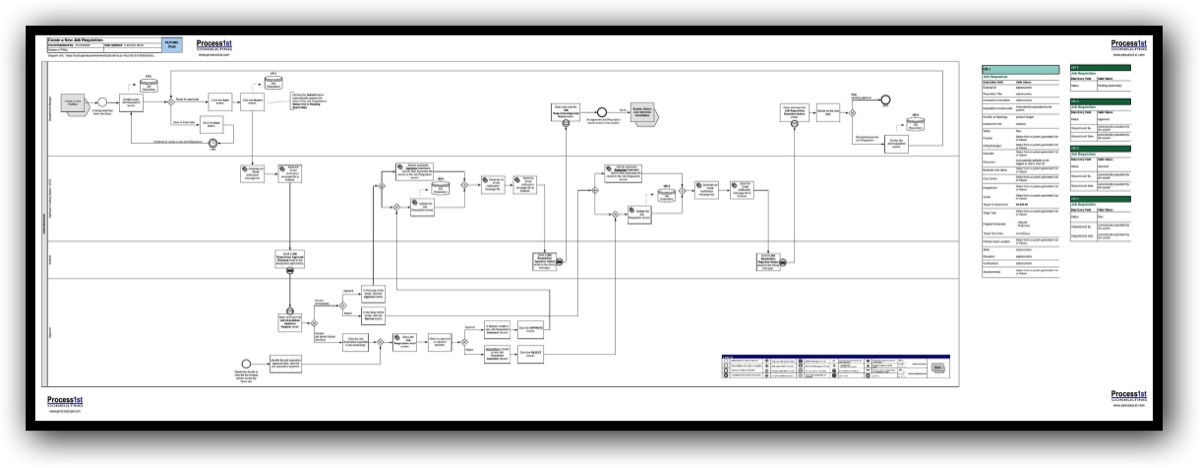
Click here, or on the image above, to see a high-resolution image of this business process map.
Other Types of Process Maps We Create
- DMN (Decision Model and Notation) Diagrams
- CMMN (Case Management Model and Notation) Diagrams
- SIPOC (Supplier, Input, Process, Output, Customer) Maps
- Value Stream Maps
- UML (Unified Modeling Language) Diagrams
- Data Flow Diagrams
Contact Process1st today
for more information.